image

image

Wednesday, February 26, 2014

The Rice and the Chessboard


The Rice and the Chessboard


1)   There is a man who invented the chess game and showed it to the emperor of India, and therefore the emperor fell in love with the game and asked the man to name his rewards and whatever he wishes for.  The man asks the emperor to give him one grain for the first square of the chessboard, tow grains for the next square, four for the next, and son on for all 64 squares, with each square having to double the number of grains. The emperor agreed to his offer and was impressed by his simple request. Days later, his treasurer informed him that this reward would add up to enormous sums that could possible be produced in many centuries.


2)   In this story,  I find it easy to grasp how functions like “doubling” makes numbers grow, these function are called “exponential functions” and are found every where around us. So, when the ma asks the emperor to fill the first square with grains until he fills up the 64 squares, he will double and add up to huge amounts.  This also represents an exponential growth function because the value of an exponential function always increases in this case. Plus, the value doubles, so like everything x increases by 1, the value of the function doubles.


 3) I believe literature is an effective way to teach and learn a mathematical concept to develop understanding and develop my skills. It requires people of all ages to think about what words and numbers mean in real life. Math in literature is an ideal context in which to discuss exactly what words mean. For example, some time people learn how to use language and mathematical thinking helps in many areas because everything has a connection to math, and math connects to everything. Also, most stories depend on logical ideas, such as classifications and conditionals. This helped me connect my math concepts through reading the story and then develop related math ideas and conclusions. 

Weslandia

Weslandia by Paul Fleischman


This book tells a story about a boy named Wesley, who is curious about the civilizations around him. He decides to build his own civilization in the back yard as a summer project. he wanted to farm his back yard based on some knowledge and information he gained from school. His civilization includes staple crop, unknown plants, fruit, vegetable, and sun dial. Wesley created his own numeric system based on 8 numbers and his own language to name and number his products and he named it "Weslandia,". In the end of the story Wesley becomes a good friend with his classmates who once made fun of him.


This book is a great book,the story is all about a boy who is very different from everyone else. Wesley is not a geek kid or book smart boy, he's is able to use his information and knowledge an apply it in real life. Wesley perfectly is able to mange his resources (input) and later his products        ( outputs). He uses his outputs and products for clothing and shelter as well.


Wesley made his own math system based on the number eight, the number of petals on the red flower of the plant. He made himself some cloths and hat from the strips of the plant's woody bark. He sells the seed oil to his former enemies as a suntan lotion/mosquito repellent for 10 dollar per bottle. Basically, to run a civilization you need some math knowledge and I think Wesley is great business man
Blog Post #3

Curious George: Roller Coaster
H.A. Rey

In this book, George and the Man in the Yellow Hat go to a theme park. George's friends had already ridden the biggest roller coaster, the Python 3,000 before he got there! George went to go on the ride, but he wasn't tall enough, he was only 4 candy strings tall when he needed to be 5. Throughout the day, he does various things to make him grow, like eat leaves like a giraffe, sleep like a baby, and stretch. Throughout the day, he was nibbling on his candy string that he was using to measure himself with. By the end of the day he thinks that he has grown because it takes more candy strings to measure him, when in actuality he hasn't grown, the candy string is just smaller. After the Man in the Yellow Hat explains this, George is sad because he still can't ride the ride. But then the owner of the park comes up and says they have a special measurement for monkeys, and george can ride!

    This book demonstrates measurement and addition because George is trying to measure himself throughout the book. His main problem is that he is making his measurement tool smaller and smaller, so in actuality, he is really not growing at all. George has a hard time with this concept.

    Literature is an effective way to teach children about math because they are being taught without even realizing it. Children love books and love being read to, so if they are being taught math while doing something fun that they love, everyone wins!


Tuesday, February 25, 2014

Blog post 3

1. The King's Chessboard is a story by David Birch. This story is about how the king of India insists that a man be rewarded for his service to the king. The man does not wish to receive a reward and that just doing work for the king was rewarding enough. The king does not except this answer and the man says that starting the next day he will receive a grain of rice for the first square on the king's chess board. The next day for the second square he will receive 2 grains of rice after that 4 grains then 8 and so on. For each square, the man wishes to have twice the number of grains for the square before it. The wise man begins to receive bags on bags of rice and eventually the king runs out of rice and cannot supply the necessary amount. They decide to end the rice agreement and the wise man continues to serve the king.

2. This book describes the principles of exponential growth. It discusses that the king and the man arrange for there to be 2 times the amount of rice (x^2) for the previous day.

3. I believe literature is an accurate way to teach math because it shows a fun and descriptive way to engage kids of all ages in the education of a specific topic in math. Mathematical topics typically can be very complicated and the pictures and vivid stories are a great way to keep people interested and get a concept across

Seeing Symmetry by

https://www.youtube.com/watch?v=lGs676XuDwY

1. This book is basically about symmetry. Like ALL about symmetry. In the book, the author explains what symmetry is and its importance, as well as showing a multitude of exampled of symmetry and asymmetry. There isn't really a story so much as an explanation as told through pictures in a picture book


2. This book was a really cool way to introduce kids to the concept of symmetry. Showing the images of the horse and the hubcap, and other contrasting images to really drive in the difference between symmetrical and asymmetric figures. I liked the fact that it used everyday objects, like boots, snowflakes, ladybugs and others to describe the difference. The author even touched on rotational symmetry and how it can be found throughout nature AND machinery. Additionally, she talked about transformations and the relation of transformation of symmetry.

Blog Post 3

Lemonade for Sale

1.  In this book the kid's tree house has begun to break and they have run out of money in their piggy banks!  So the kids decide to make a lemonade stand to make some money and decide to record their sales with a bar graph in order to keep track of how much they sell on different days.
2.  The mathematical concept that is represented in this book is the use of bar graphs to record real world data with the kid's recording how many glasses they sell on which day.
3.  I think that literature, especially picture books, is a good way to teach a mathematical concept because the concept is broken down into a story.  the context that the concept is used in can help a person to learn it because it is being applied to a specific scenario.

The Kings Chessboard

One of the first stories I read in grade school was the story "The Kings Chessboard". While this is essentially the same story as "One Grain of Rice", the day we read that in class I remembered the Kings Chessboard and it was one of my favorite stores in grade school.


1) "The Kings Chessboard"by David Birch starts off in Ancient India. A wise man who performed many good services for the King is summoned before him and granted a reward. The Wise man refuses to accept a reward from the King until the King gets angry. Eventually, the Wise Man decides to ask for a piece of grain per square on a chessboard and for each day that passes, so 64 days, with the amount of rice doubling per day. The court laughed at his request and everyone thought he was insane. Is the Wise man insane however? And will his request lead to just a simple small amount of rice, or so much more?

2) The King demands that the Wise Man accept a reward from him, so after some quick thinking the Wise Man decides that the King will grant him a grain of rice for every piece on a chessboard but for every next piece on the board the amount from the previous square will double. For the first square of the the chessboard, the wise man will receive one, for the second square two, the third square four, and so on. Eventually, the King stopped keeping track of the rice, but the servant and the royal weigher, who were in charge of bringing the rice to the Wise man noticed that the amount of rice was getting out of hand quite quickly. The Weigher was too scared to tell anyone about the imminent problem and the rice continued. As each day passed, the amount of rice grew and grew, until "one grain became two, then one ounce became two ounces, a pound became a pound, and so on". The final number came to 549,755,830,887 tons of rice. The King realized that there was not enough rice in India to fulfill this wish and eventually summoned the Wise Man to ask him to release him from the debt. The two converse and the Wise Man releases the King from the rice debt.

The story of the "Kings Chessboard" shows the power of exponential growth. The rice grows from the second day on by 2^x.
Day
1- 2^0= 1
2- 2^1= 2
3- 2^2= 4
4- 2^3= 8

and so on until 2^63, which is 18,446,744,073,709,551,615 grains of rice. This is a fun and creative way to introduce kids and even adults to the power of exponents. Using the board helps show that as you move to the next square, the number is doubled from the previous one.

3) Literature is a great way to teach math because it puts everything in an easy and straight forward way to think about it. Exponents for example can be hard to follow since it is figuring out the difference of doing math 2 times 3 versus the exponent 2^3 and doing 2 x 2 x 2. The Chessboard puts it into an easy to understand representation of how exponents work. Literature and visuals offer an alternative to dense math lecture and can break it down using real world concepts that we all live with to help us understand.

Blog Submission #3

Infinity and Me
By: Walid Bouaichi


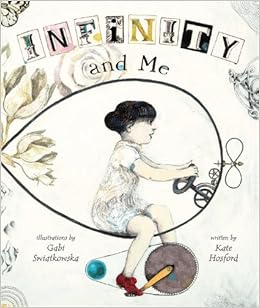
1. The book that I chose to use is Infinity and Me by Kate Hosford. This book was quite interesting and would be enjoyed by any kid and their parents. This book begins with a little girl named Uma who cannot seem to sleep so she decides to go outside. Once she is outside she begins to look up at the sky and starts to to count the stars, eventually realizing that she cannot count all of them. Uma then begins to question what is infinity, could it be number that grows forever, an endless racetrack, or even an ice cream cone. She then finds out that infinity is the love that she has for her grandmother. 

2. The mathematical concept in Infinity and Me is infinity. Infinity is the idea of something that has no end. . It does not have any limits and for this goes on forever, always continuous. Infinity is always represented as a side ways number 8. Infinity and Me does a great job of representing the concept of infinity. Uma ttys to count the stars but notices that they are infinite and it is impossible to count all of them. The author highlights the love that Uma has for her grandmother as being infinite as it goes on and on and never ends.  

3. Literature is an effective way to teach mathematical concepts because written, real life examples are always easy to understand and help teach the content better. Even though this book was fairly simple, the concept that it taught was not. Using real life examples like counting stars, your love for someone can really help someone understand a concept as complicated as infinity. 

Lemonade for Sale


Lemonade for Sale by Stuart J. Murphy

Lemonade for sale is a story about 4 kids that live on elm street who entertain their selves with a club house (decorated hammock), that happened to be falling apart, so they wanted to repair it. After realizing that they have no money left in their piggy bank, one of the children, Danny, suggests that they make 30-40 cups of lemonade to accumulate money for the their broken down club house. Sherry suggests that they keep track of sales via a bar graph. On Monday they sold 30 cups, 40 cups on Tuesday, 56 cups on Wednesday, 24 cups on Thursday, and more than 90 cups on Friday. On Thursday they realized that a new neighbor was taking their customers by juggling on the corner. They invited the juggler to juggle by the lemonade stand and sales skyrocketed on the graph, which allowed the kids to have enough money for their clubhouse. Hooray!
 Lemonade for sale does a great job at depicting how to graph data. The book didn’t explain independent and dependent variables, but if there was a mathematical lesson based off of the book, one could show children that the days listed at the bottom of the bar graph were the independent variables and the cups sold, on the y-axis, were the dependent variable. I think the book made a good choice by choosing a bar graph to the plot the information, since bar graphs are the easiest. However, the author could have decided to plot the data with a scatter plot.
Literature is a great way to teach mathematical concepts because it visually depicts the mathematical scenario. In my opinion having a visual example of a math problem helps me recall definitions and concepts better. Also, kids will enjoy learning if the learning process is engaging and fun. Involving literature with pictures is a great way to contingently appeal to a diverse pool of needs.

Infinity and Me Jaime Gottlieb Post


  Infinity and Me

 By: Jaime Gottlieb

1.) The book I chose is Infinity and Me and was written by Kate Hosford. The book begins with a little girl who goes outside after she just got new red shoes and couldn’t sleep. So she decides to go outside and look at the stars. When looking at the stars, she thinks to herself, she tries to count them, and realized she couldn’t count all of them. Then she goes to the ice-cream store, and thinks about what would happen if she could always lick ice cream (this is when she asked someone what that concept is). Then she thinks about it even more, and wonders if infinity is and endless racetrack. In the end, she comes to the conclusion that infinity is a thing because she has endless love for grandmother – infinity.


2.) The mathematical concept that this book defines is infinity. Infinity is an abstract concept describing anything without limits. In this story in particular, Uma(the main character), imagines infinity as an endless racetrack. She finally comes up with the fact that it is infinity through forever in the end when she was talking about her grandma and her love for her.

3.) I believe literature, specifically picture books with minimal words is an effective way of teaching because it is simplistic. When a person sees something in a simplistic manner, it is easier to understand. This was a great way to understand the mathematical concept of infinity.
                                                                                                                                                                                  

Blog Submission #3

Stephen Allen


1. Lemonade For Sale: By Stuart J. Murphy

http://ecx.images-amazon.com/images/I/61A4K9G9SVL.jpg
 
The kids' club house is falling apart so they decide they need to sell lemonade to make some money. They decide selling about 30-40 cups each day would be enough to fix their clubhouse. Sheri will keep track of the sales with a bar graph. On Monday they sold 30, Tuesday 40, Wednesday, 56, Thursday 24, and on Friday they sold so many cups that the number went over their original top of the bar graph. They were able to repair the clubhouse and the juggler joined their club.

2. This book teaches the reader about bar graphs. I teaches the reader how to draw a bar graph and properly label each axis. The book does a great job at teaching children what a bar graph is and how to plot data on one.

3. Picture books are a great way to combine entertainment with math. This is necessary to teach small children who are easily bored and distracted by complex and dry material.

Mystery Math Master


https://blogger.googleusercontent.com/img/b/R29vZ2xl/AVvXsEhz_0UtMyiitocBk05M4-_2LXBbKuBamNrFeEmYtGDvV9WkmkJWGZQ4qq4pB1j-gpq4Hc3qjV_feV9Fu_G5eTI1VEaNMpPAD4ES7NeOWOihnyDOFhdLtUmJKFjJDC2JLuSYTUF1OIPS9ccm/s1600/math.jpg

1.  Mystery Math, written by David Adler, introduces young readers to algebra in an entertaining and effective kids book.  Using the playfully spooky setting of a haunted house, two children solve the house's riddles using algebra. Opening with the universal truth that two sides of an equation must be balanced, Adler ensures children understand that equations must be set to equal each other. 

2.  Throughout the book, the children face a number of challenges, solving for "mystery numbers", otherwise known as variables.  Igor, the green-faced caretaker, poses word problems that can be solved using algebraic equations—for example, if Igor saw bats flying around earlier, saw 12 more fly in, and there are 27 bats now, how many were in the house before?  Much of these challenges are only simply addition, and not complicated concepts like parabolas or derivatives. 

3.  Literature offers a lens, or presentation method that provides a bit more context and beleivability than standalone mathematical lectures or problems.  Literature can engage it's audience, and while it undoubtedly takes more time to teach the concept, the readers will likely be able to frame their understanding of a given concept in a more concrete way.

Mathematics in a Story - Christopher Counting


Summary

The title of the book is Christopher Counting, written by Valeri Gorbachev.
The story starts where Christopher Rabbit sitting in class while his professor was teaching the class counting 1 to 10. Then after Christopher left school he started to count everything he sees on his way, the story shows how much Christopher loves counting. Ever since he learned to count at school, he counts everything. He counts everything in his backpack; he counts everything in the house; he counts steps as he walks downstairs; he counts times of the stone skipping on the water; he counts when he plays hide-and-seek with other friends. Finally when it is time to bed, Christopher is so exhausted because of counting all day. Before he is urged to bed by his mother, he suddenly remembers he forgets to count something -- STARS! When Christopher sits on the front porch and counts the stars in the sky, he finally realizes that it is impossible to count everything!

I don’t have enough knowledge on books for children. So, I chose it based on the title and after I read the story I found how much I can relate math to a simple story like Christopher Counting.


Ways in which it relates to Math

Input/Output
Geometry
Parabola
Calculus/Leibniz

The story starts with a classroom having 8 students, one of them is Christopher the rabbit. All were sitting on their desks, each desk was a rectangular shaped having  (length * width) and 4 angles. Ms. Goat was teaching the students how to count through a basket of oranges demonstration. The input here is Ms. Goat who was giving new information/numbers and how they should be counted for her students. The output was every student who was repeating after her the numbers. Christopher rabbit loved the new topic he learned counting from 1 to 10. He left school counting everything he sees. His cubic shaped aquarium of fish that has 8 vertices/ corners, 12 edges and 6 faces/sides, and circle shaped plates with radius, diameter. All his stuff were counted!
Then Christopher Rabbit decided to discover the outside and see what he can count there, he went to a close by lake and saw Beaver throwing stones into the lake. The picture shows how Beaver was making continues parabola with circular waves; the wave has 3 dimensions.
So, all the parabolas Beaver created were facing down because in our quadratic function
ax² + bx + c   if a < 0 then the parabola opens down.

Finally, Christopher rabbit decides to leave Beaver and go somewhere else to count everything!
Before he went to bed he decided to count the stars, and he gave up and started crying because he found out that counting the stars was just impossible. That’s what we call infinity – after I searched for it I saw a familiar name from our class, Leibniz, was the co-inventor of infinitesimal calculus. To Leibniz, both infinitesimals and infinite quantities were ideal entities, not of the same nature as appreciable quantities, but enjoying the same properties” Wikipeda

Infinity in limits where something doesn’t have limits ∞. For example, the set of integers is countably infinite, while the infinite set of real numbers is uncountable.


Why is literature an effective way to teach/learn a mathematical concept?

I do believe that literature makes things easier like math. Instead of working with numbers, we apply math to stories or we extract math from the story. It does make a difficult concept more understandable in an easy way. Also, it makes math fun for all ages especially kids since I did go through a child’s book having no clue I would find one thing related to math.
So, in my opinion literature has a good effect on teaching and a faster way for understanding.
If we get functions, formulas and math concepts out of simple stories like Christopher Counting then math shouldn’t be a nightmare for most kids =)